


Response to “Context Matters”
Updated: Jun 29

After reading the recent letter to the editor in the Tracy Area Headlight Herald titled “Context Matters,” I found myself thinking, “Oh boy, here we go.” The headline itself is correct: context does matter. That is exactly why several important details should not be left out when discussing property rights, business plans, tax-forfeited parcels, and public decision-making in Tracy.
I also want to note that I was having a conversation about this specific writer prior to last week wondering when they will send him to throw his two cents in to the hat. I should have bought a lottery ticket.
The purpose of this response is to address the letter item by item so readers can compare both perspectives, review the original article and letter, and decide for themselves. A complete picture requires more than selected facts. It requires the full timeline, the omitted details, and an honest look at how certain narratives are formed in this community.
The letter begins with the familiar saying that there are three sides to every story: your side, my side, and the truth. That may sound fair on the surface, but it also raises an important question: are facts being presented fully, or are key details being omitted in order to continue a preferred narrative? In Tracy, it often appears that certain well-established, well-connected individuals and prominent farmer expect their version of events to be accepted as the only version that matters.
The writer refers to coverage from the April 30 edition of the Tracy Area Headlight Herald and states that the adjacent property owners explained at the April 13 City Council meeting that they intended to establish an outdoor storage facility on land west of the community center. That statement is false and lacks important context. The two property owners did not present those business plans at any City Council meeting.
The information was discussed during a phone conversation with Per Peterson of the Headlight Herald regarding a cease-and-desist letter that had been sent to the City of Tracy and the awarded contractor after multiple trespassing concerns were documented. This conversation was recorded with Per Peterson just in case a “context matters” narrative such as this decided to present itself.
Those trespassing concerns were not hypothetical. Several complaints were documented, and two were reported to Police Chief Jason Lichty. In our view, those complaints were not properly processed or addressed. After repeated attempts to protect private property rights, those concerns fell on deaf ears. That is the context that should have been included. Would a prominent farmer or connected business person from a Tracy Development Corporation trespass complaint been treated differently?
The storage idea was also made known through a “coming soon” sign placed on the property. It was not some secret plan introduced later to fit a narrative. It was discussed as part of a larger property-rights and business-planning issue after the original indoor-storage concept involving the former ADO building was no longer viable.
To add to the “Context Matters”.
There is a Property of a prominent business person who bought a corner gas station and was granted certain opportunities and in doing so placed a large “Coming Soon” sign on said building. Nothing came… Did this business idea receive the same viability treatment as the two property owners? The answer is No, as he sits at the head of the table of said Tracy Development Corporation.

The writer also discusses the former ADO building and the timeline of ownership. For context, the purchase transaction between Von Bokern RT and Sahlstrom was completed on September 20, 2024, for $43,800. The later transaction between Sahlstrom and the City of Tracy was completed on December 20, 2024, for $150,000. That was roughly three months later at a $106,200 increase.
Just because the first phase of a potential business plan did not happen does not mean the second phase could not still be viable. Business plans change. Circumstances change. Responsible property owners reassess the facts and determine whether a modified plan still makes sense.
There is also broader context regarding the timing of tax-forfeited property sales in Minnesota. Prior to our purchase, Minnesota had been responding to several major court decisions involving tax forfeiture, including a Tyler v. Hennepin County. That class action case reached the United States Supreme Court and a 109 million settlement that led to significant changes in how Minnesota handles tax-forfeited property.
The state of Minnesota wanted to stay far away from enacting a tax property forfeiture moratorium. So what the state of Minnesota decided to do was overhaul its forfeiture laws. This caused all the counties in the state of Minnesota to not stop auction sales but temporally adjust tax forfeiture sales until several criteria's where met. So what did that mean for two potential bidders? We had to wait until those counties adopted the new laws from the outcome of several court cases. "This Context Matters".
The writer asks why the outdoor parcel was acquired after the indoor facility was no longer available. The answer is simple: the property owners reassessed the situation. Losing the indoor option created a setback, but it also created a different business analysis. An outdoor storage concept has different costs, different logistics, and different tax implications than a temperature-controlled indoor facility. There is no building to heat or cool, no physical structure to maintain in the same way, and potentially lower operating costs.
That does not mean the plan was careless or rushed. It means the property owners evaluated the pros and cons and considered what steps would be necessary, including a possible zoning change or conditional use permit. Those discussions have not even been formally brought before the City yet. The writer speaks as though he has personally reviewed our business plan. He has not.
The writer also searched Lyon County public records and pointed out another property we purchased. Again, context matters. During our assessment of the outdoor storage concept, one major logistical issue became clear: snow placement. If storage units or structures were placed on the property near the community center, where would snow go during a heavy winter? That is not a minor issue. Snow removal affects access, safety, and operating costs.
The additional lot made sense because of its location and accessibility. It provided a practical solution to a foreseeable snow-management problem. No one else bid on that lot except us. The EDA or another local development entity could have pursued it if they believed it was important. They did not.
It is also worth noting that the same tax-forfeited property west of the now Tracy community center had apparently been used by other business’s over the years as a convenient place to push snow. Once that property was purchased, that informal use changed. Maybe that is part of the frustration of the writer in question as he owns the JFS Building. Maybe the issue is not really about business viability at all, but about the fact that two private property owners purchased parcels that others assumed would remain available or controllable. Now those Business owners have to face the same logistical question we had. Since “context matters” what are those business’s going to do during a heavy snow season? Did the writer do a logistics analysis himself?
That is why the “Monopoly board” comparison fits.
In Tracy, it often feels as though certain connected groups and individuals have long believed they control which properties move forward, which opportunities are supported, and which people are allowed to participate.
When two people outside that circle purchase property and attempt to do something productive with it, suddenly everyone has questions, concerns, and opinions.
I have another “Context Matters” question: Why are the EDA and the Tracy Development Corporation involved in ways that appear to overlap? The Tracy Development Corporation appears to be acting in a role similar to an EDA, yet it is essentially a non-governmental organization. At the same time, the writer’s father and/or relatives are on to that board.
Let’s not forget Jeff Carpenter, who is listed as an advisory member.
Possible conflict of interest?
‘Context matters.’
The writer could have called. He could have asked questions. He could have opened a dialogue before publishing assumptions. Instead, he chose to write a letter suggesting that key context was missing while omitting important context himself.
The real context is that Tracy has long struggled with concerns about favoritism, selective opportunity, property control, and unequal treatment. The Tracy EDA and related development interests hold or influence many parcels and opportunities in this community. Many properties do not appear to move unless the right people are involved. That is a fair issue for public discussion.
The two property owners are not asking for special treatment. They are asking for equal treatment, property rights, and a fair opportunity to pursue a lawful business idea without being targeted by selective narratives.
So yes, context matters. It matters when discussing business plans. It matters when discussing tax-forfeited property. It matters when discussing trespassing complaints. It matters when discussing who gets opportunities in Tracy and who does not. And it matters when public letters are written about private property owners without first making a good-faith effort to understand the full story.
The writer is welcome to reach out and have that conversation. The contact information is on the sign near the property. Dialogue is always available.
I will close with one question: if I wrote a letter to the editor about confined pig operations, business viability, or day-to-day farm operations without first contacting the farmer involved, would that be considered fair? Or would I be told that I failed to include important context?
I do not come from, nor am I part of, a prominent farm family. I do not participate in a non-governmental organization acting as an EDA, where someone’s father or relative sits on the board. I do not have special access to certain city council members, city staff, or city administrators — and I choose not to participate with people who operate that way.
I will not sell my soul to be part of something that suppresses opportunities for others. What I do have is toughened skin, strong enough to handle the misinformation arrows thrown under the disguise of phrases like “context matters.”
I have a loving wife who stands by my side unconditionally, and her family’s homes are not surrounded by allegations of infidelity or moral compromise like some we will leave unnamed. I have true friends who are loyal to me, and I am loyal to them in return.
Those are the values that define my wealth, my strength, and my moral fiber.
Because, after all, context matters.
The other property owner would like to say “It’s a free world as long as you do what we tell you too”
Link To Tracy Development Corporation Website
Tracy Development Corporation Facebook Link

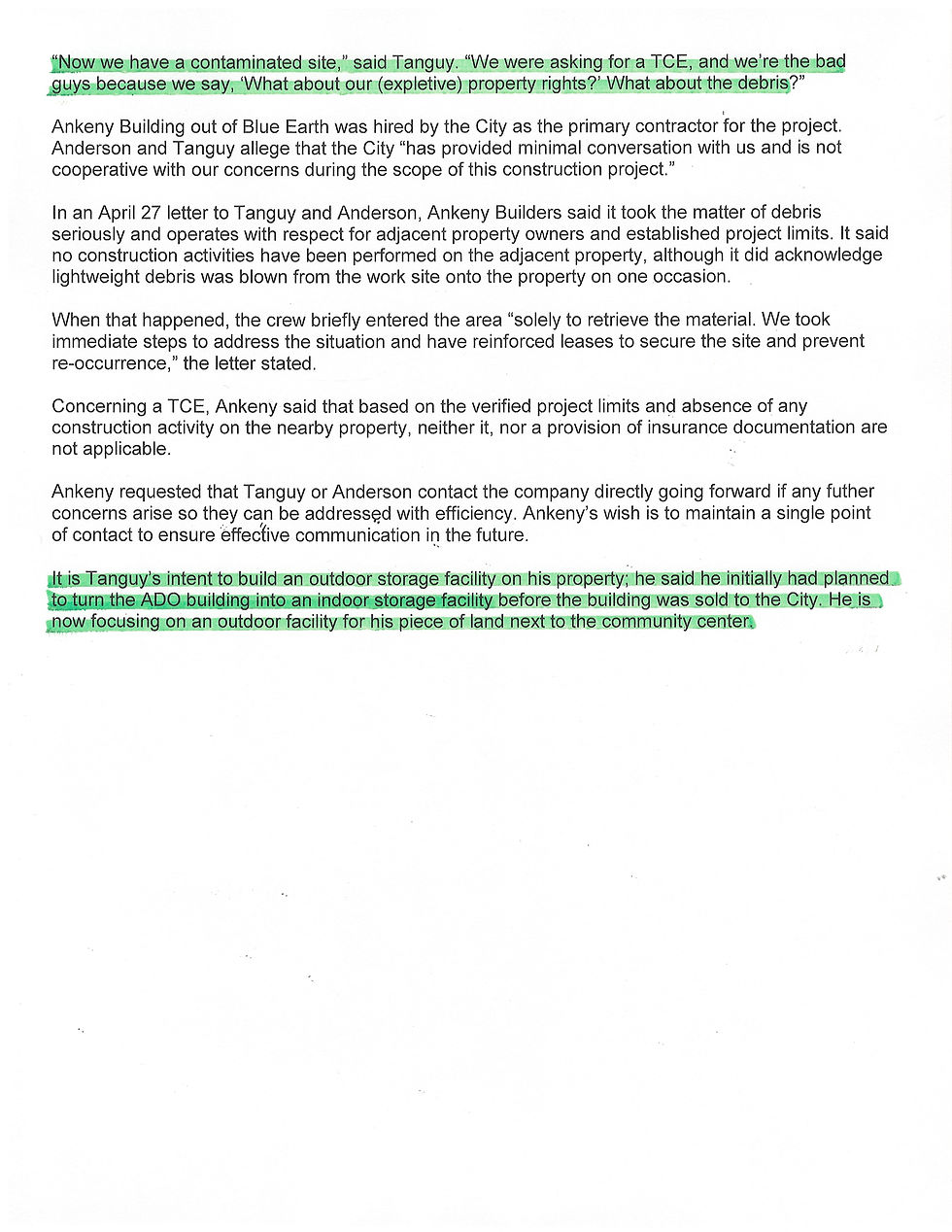
Original Letter To Editor Below
Context matters
“There are three sides to every story: your side, my side and the truth. And no one is lying.” This well-known observation by Robert Evans highlights a common challenge in public debate: the impact of the “half-truth.” A half-truth presents a portion of the facts while omitting critical context, which can inadvertently create a misleading impression. Because it contains verifiable elements, it can be difficult to recognize and address.
In public discussions, relying on partial information often stalls productive dialogue and erodes trust. A clear example of why complete context matters can be seen in the ongoing discussions surrounding the new Tracy Community Center.
According to coverage in the April 30th edition of the Tracy Area Headlight Herald, the adjacent property owners explained at the April 13th City Council meeting that they intend to establish an outdoor storage facility on their land west of the community center. They noted that their original plan was to convert the former ADO building into an indoor storage space before it was sold to the City, leading them to shift their focus to the outdoor lot next door.
However, evaluating the full timeline introduces important context. The former ADO building was purchased by the Sahlstroms in the summer of 2024, and the City of Tracy subsequently acquired it in December 2024. Public records indicate that the adjacent property owners did not purchase the land next to the community center until December 2025, a full year after the City owned the building.
If the primary business objective relied on a combined indoor and outdoor facility, it raises a reasonable question as to why the outdoor parcel was acquired a year after the indoor facility was known to be unavailable.
Furthermore, a public search on the Lyon County GIS interactive map shows that these same owners also acquired a separate piece of land — a portion of the vacant lot directly east of the community center — which is bordered by parcels owned by the Tracy Economic Development Authority.
From an outside perspective, acquiring two separate, vacant lots flanking either side of a major public project presents an unusual layout for a standard storage business.
Healthy public debate depends on complete transparency rather than selective details. For the community to discuss this issue constructively, knowing the complete timeline is essential to seeing the full picture.
JAY FULTZ TRACY
Here is the response that will be delivered to the Tracy Headlight Herald. The Guidelines for letter to the editor submissions state approximately 300 words and several other criteria such as no personal attacks which essentially the writer did to me with the lack of context. The response below was trimmed to meet those guideline's
NO NEED TO READ RESPONSE OF LETTER TO THE EDITOR SUBMISSION BELOW - JUST HERE FOR TRANSPARENCY & CONTEXT
Response to “Context Matters”
After reading the recent letter to the editor titled “Context Matters,” I agree with the headline: context does matter. That is exactly why important details should not be left out when discussing private property rights, tax-forfeited parcels, business plans, and public decision-making in Tracy.
The letter suggests that the property owners presented outdoor storage plans at the April 13 City Council meeting. That is not accurate. Those plans were discussed during a phone conversation with the Tracy Area Headlight Herald regarding a cease-and-desist letter sent to the City of Tracy and the awarded contractor after repeated trespassing concerns. Several trespassing issues had already been documented, including complaints reported to Police Chief Jason Lichty, which we believe were not properly processed or addressed.
The outdoor storage idea was also made public through a “coming soon” sign on the property. It was not a secret plan created after the fact. The original indoor-storage concept involving the former ADO building was no longer viable, so the property owners reassessed their options. Business plans change. Outdoor storage has different costs, logistics, zoning considerations, and tax implications than a temperature-controlled indoor facility.
The writer also questioned the purchase of another nearby lot. Again, context matters. During our review of the outdoor-storage concept, snow placement became a major logistical issue. The additional lot provided a practical solution for snow management, access, and safety. No one else bid on that lot. The EDA or another development entity could have pursued it if they believed it was important, but they did not.
It also appears that the tax-forfeited property west of the community center had been used by others over the years for snow placement. Once private owners purchased that land, that informal use changed. Maybe some of the frustration is not about business viability at all, but about losing assumed control over a Delinquent tax forfeited property for placement of snow.
This is where the “Monopoly board” comparison fits. In Tracy, it often feels as though certain connected groups and individuals believe they control which properties move forward, which opportunities are supported, and who is allowed to participate. When people outside that circle purchase property and attempt to do something productive, questions and criticism suddenly appear.
There is also broader context regarding the timing of tax-forfeited property sales in Minnesota. Prior to our purchase, Minnesota was responding to major court decisions involving tax forfeiture, including Tyler v. Hennepin County. That case reached the United States Supreme Court and led to significant changes in how Minnesota handles tax-forfeited property. Rather than stop tax-forfeiture sales entirely, Minnesota overhauled its forfeiture laws, which caused counties to temporarily adjust auction sales until new legal requirements were met. For potential bidders, that meant waiting until counties adopted and implemented the changes resulting from those court decisions. This context matters.
The property owners are not asking for special treatment. They are asking for equal treatment, respect for property rights, and a fair opportunity to pursue a lawful business idea.
So yes, context matters. It matters when discussing business plans, tax-forfeited property, trespassing complaints, development influence, and who gets opportunities in Tracy. Dialogue is always welcome, but assumptions should not replace facts.
George Tanguy Tracy
Please Sign up and Subscribe to our Blogs for continued content. The area to access that is on the home page at the top and the bottom. Share our content on social media and show support by sharing wit friends & family in the Tracy Community.


Comments