


Rewind the Tape: Do the Public Records Match Jeff Carpenter's Statement At City Council Meeting ?
Updated: Jul 5

On May 20, 2026, we published our first investigation, "Questions Emerge Over Possible Fuel-Contaminated Soil at Tracy Community Center Project." Since then, additional public records, witness statements, and documents obtained through Minnesota Data Practices Act requests have raised new questions about how the discovery of petroleum-contaminated soil at the Tracy Area Community Center was handled.

At the Tuesday May 26, 2026 Tracy City Council meeting, City Administrator Jeff Carpenter addressed the issue during his public comments.
Link to Jeff Carpenter statement at city council video below
Approximately 46 seconds into the video his remarks, Carpenter acknowledged that petroleum-contaminated soil had been encountered during excavation, characterizing it as "no huge deal."
At approximately 1 minute and 6 seconds, Carpenter told the City Council that the contractor "did what they were supposed to do" and contacted the Minnesota Pollution Control Agency (MPCA).
Those statements are part of the public record.
However, after comparing Carpenter's timeline with MPCA records, witness statements, and other public documents obtained through data requests, significant discrepancies appear to exist between the timeline presented to the City Council and the documented sequence of events.
We encourage every reader to review the council meeting video alongside the records presented here and draw their own conclusions.
Timeline Based on Public Records and Witness Statements
Wednesday, May 6, 2026
Excavation began on the east side of the Tracy Area Community Center for installation of a new sewer line.
According to multiple witness statements, nearby property owners noticed a strong petroleum odor coming from the excavation that day.
Thursday, May 7, 2026
According to a witness statement, a concerned Tracy citizen spoke with the excavation operator regarding the odor.
The operator stated to the concerned citizen that the City had already been notified and that they had been instructed to place the contaminated soil back into the excavated trench and deal with it later.
If accurate, this statement raises an important question:
Who gave that instruction?
The excavation reportedly continued below the approximate four-foot depth referenced during the City Council meeting.
Witnesses further stated that:
no trench box was being used,
no specialized personal protective equipment (PPE) was observed,
no air monitoring was observed during excavation in contaminated soil.
The trench was more than 7 feet deep.
These witness statements differ from portions of the explanation presented during the May 26 council meeting.

Friday, May 8, 2026
At approximately 1:00 p.m., the concerned citizen collected one bucket of petroleum-contaminated soil as evidence.
During the City Council meeting, Carpenter stated that two buckets had been removed.
Witnesses dispute that account.
Witness statements also indicate the soil was accessible directly from the public sidewalk and that the work area had not yet been secured and there was no signage along the sidewalk stating otherwise.
According to those witnesses, there was no need to climb onto the soil pile to obtain the sample.
Shortly after the sample was collected, the excavation contractor reportedly made several phone calls.
Within approximately fifteen minutes:
orange snow fencing was installed,
the excavation was shut down.
Later that evening:
a second MPCA complaint was submitted on the Tracy Area Community Center,
an OSHA complaint was filed after photographs and witness statements had been collected.
During the May 26 council meeting, Carpenter referred to two OSHA complaints.
Available records reviewed for this investigation identify one OSHA complaint filed at that time.
Why would Jeff Carpenter omit or change those facts to fit a different narrative?
Carpenter also stated:
"It's just another ongoing that, uh...that we decide to...to harass."
That statement is also part of the public record.
Many citizens may view requests for accountability differently than Carpenter characterized them.
Monday, May 11, 2026
According to MPCA records, the excavation contractor was notified of original complainant's Duty Report on May 11—five days after contaminated soil was reportedly first encountered.
The Excavation Contractor did not contact the MPCA as Jeff Carpenter stated in the council meeting.
The remaining contaminated soil was then covered with plastic.
This timeline differs from the statement given during the May 26 City Council meeting that the required notifications occurred immediately.

Tuesday, May 12, 2026
AET personnel reportedly arrived onsite at approximately 12:25 p.m.—seven days after contaminated soil was first discovered.
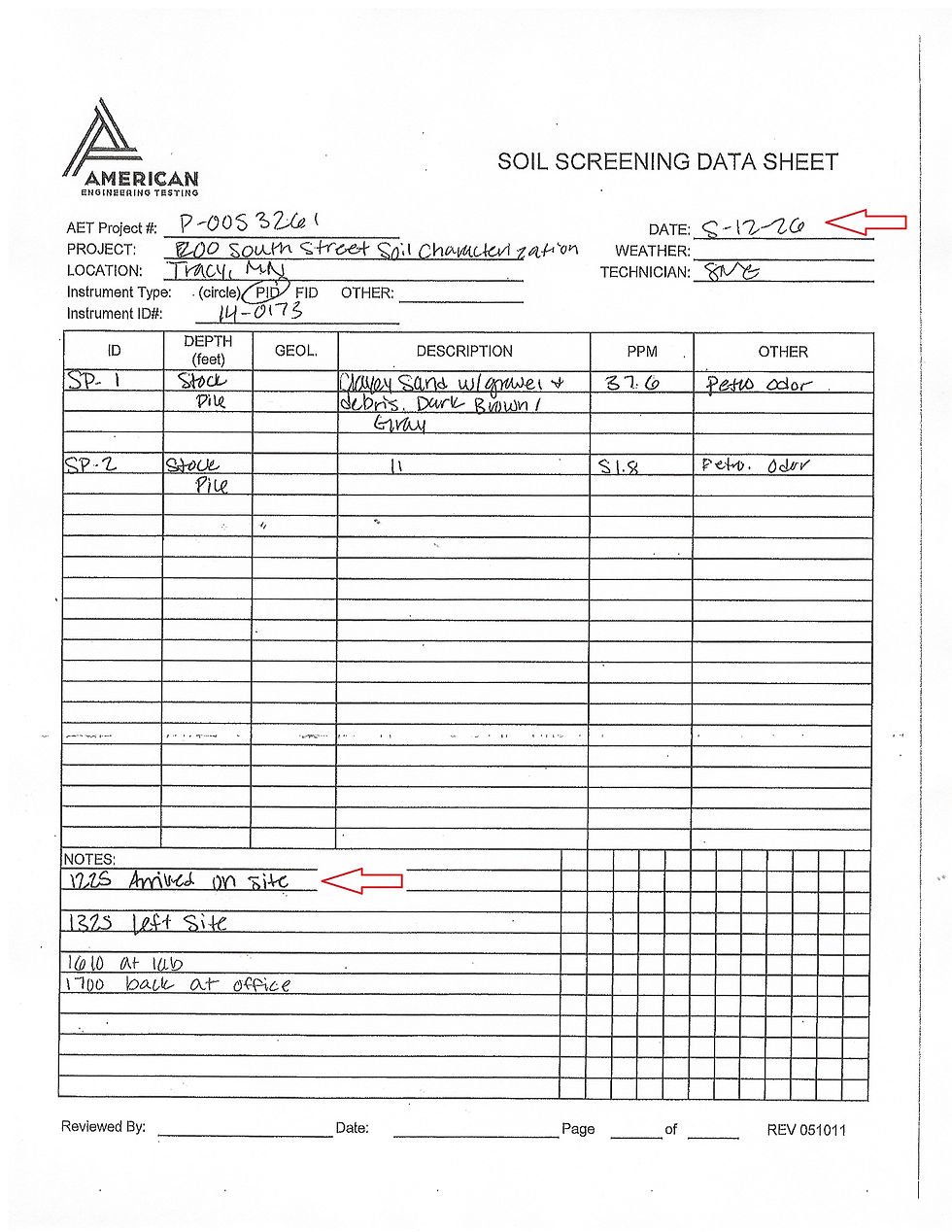
Wednesday, May 13, 2026
Ankeny submitted its Duty Report and notified Bollig Engineering.
This occurred eight days after the contamination was reportedly first identified.
Again, this differs from the timeline presented during the May 26 City Council meeting.

What Happens Next?
The Tracy Area Community Center property at 200 South Street, Tracy, Minnesota, has now been assigned an official MPCA leak site number LS0022638
Link to MPCA leak site map below


According to the MPCA process, the agency will conduct a leak site investigation to determine whether a responsible party can be identified.
If no responsible party is identified, state funding may be used to investigate the site further. That process can include:
subsurface soil borings,
groundwater sampling,
laboratory testing,
evaluation of contamination migration,
development of a remediation plan if warranted.
Depending on the investigation's findings, contaminated soil may ultimately require excavation and replacement.
Despite this ongoing regulatory process, Carpenter stated during the council meeting that "it was all cleaned up."
Whether that statement accurately reflected the status of the site at that time is a question readers can evaluate alongside the public records.
Questions That Still Deserve Answers
The citizens of Tracy deserve clear answers to several important questions:
Which City official, Jeff Carpenter or Shane Daniels, instructed that contaminated soil be placed back into the trench and it would be dealt with later?
Was any assessment conducted to determine whether petroleum contamination could affect the newly installed water line?
Has any drinking water testing been performed at the Tracy Area Community Center following discovery of the contamination?
Why does the documented timeline differ from the timeline presented during the May 26 City Council meeting?
Why was the MPCA Duty Report not submitted until May 13th if contamination was first encountered on May 6th?
Why were environmental consultants not onsite until nearly a week after the contamination was reportedly discovered?
Was adequate due diligence conducted regarding prior property ownership and potential environmental contamination before construction began?
What ethical and professional standards require a City Administrator to provide truthful, accurate, and complete information to the City Council, and what are the potential consequences if material facts are omitted or misrepresented?
How is the future narrative going to be presented when the MPCA starts its full leak site investigation?
Accountability Builds Public Trust
Government transparency depends on accurate information being provided to elected officials and the public.
When timelines presented during public meetings do not appear to match government records, citizens naturally begin asking questions.
This investigation isn't about politics.
It is about accountability, transparency, and ensuring that public officials accurately represent events involving environmental contamination on public property.
As additional MPCA records become available and the state's leak site investigation proceeds, Tracy Minnesota Accountability & Corruption will continue following this story and publishing documents so the public can review the evidence for themselves.
The facts matter.
The timeline matters.
And public trust depends on both.
Link to original story from May 20th 2026 below
Please Sign up and Subscribe to our Blogs for continued content. The area to access that is on the home page at the top and the bottom. Share our content on social media and show your support by sharing with friends & family in the Tracy Community.


Comments